 Made in France
What prints without rework
- Vector file: AI, EPS or PDF
- 230 × 85 mm at full scale
- Text converted to outlines (no fonts to supply)
- Colours in Pantone Coated, one colour = one solid
- Lines at least 0.5 mm thick
- Positive text ≥ 6 pt, reversed text ≥ 8 pt
Printing
Everything you need to prepare artwork that will go through without rework: the printable area, the file, the colours — and the print proof you sign before production starts.
The area
The print goes all the way round the body. Your file is therefore an unrolled rectangle: 230 mm of circumference by 85 mm high, a ratio of 2.7:1.
The file
The colours
Screen printing lays down one ink at a time. Each colour in the artwork needs its own screen, prepared for your order.
Screen charges are billed once per colour, on the first order of the artwork, whatever the quantity: on 125 bottles they weigh, on 1,000 they vanish. A rerun is not charged again — we keep your screens, and they print the PRO 600 just as well as the MAX 800. Changing a colour mid-run means cleaning a screen, which is charged.
On a black, navy or dark translucent body, the inks do not catch the eye without a white underlay. That underlay counts as one more colour.
Ink is laid down at a constant thickness: a colour cannot vary continuously. A gradient is therefore rendered as a halftone — a cloud of dots the eye recomposes at a distance; a photograph is treated the same way. The mesh of the screen limits how fine it can get: the dots show up close, and the gradient cuts off where they become too small to print.
A 0.5 mm offset between two colours and slight colour variations from one batch to another are inherent to the process. Avoid registration to a tenth of a millimetre.
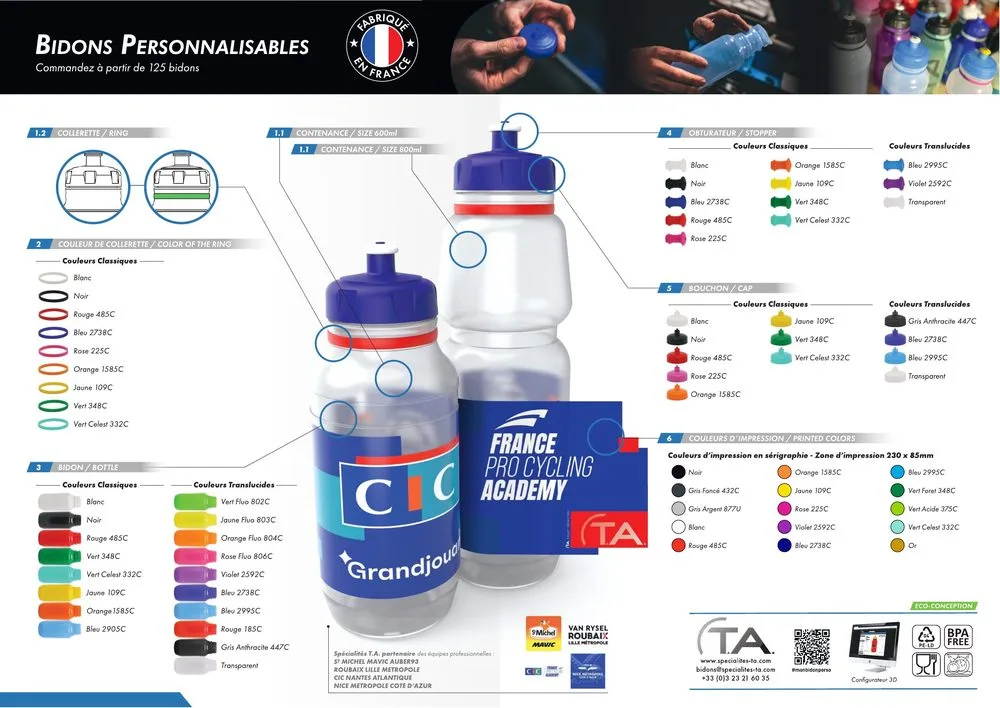
Documentation
The colours of every part — body, ring, cap and valve — and the screen-printing inks, on a single A3 sheet to keep at hand.
These colours are prepared as standard. A colour outside the chart is still possible: it requires a custom colour development, charged separately.
The print proof
Your file reaches us with the quote request, or by e-mail to [email protected]. We check the dimensions, the number of colours, line weights and Pantone equivalents, and we tell you what gets in the way.
Then comes the print proof: the finished bottle, flat and in 3D, within 48 working hours. Your written approval starts production — and any change asked for after that stage restarts the cycle.
No artwork ready? We create the design for you.
The configurator wraps your file around the bottle and shows you the result from every angle. No account needed.